Complimentary FREE Collagen Peptide Booster with all purchases over £130 + FREE Makeup Remover 30ml
29.04.2026
2 min read
UVA and UVB rays: how they damage your skin and the mistakes you should avoid

Every time you step outside without sun protection, you accumulate damage you won’t see today—but your skin will remember in ten years.
Ultraviolet rays are not just an aesthetic concern: they are the main external factor behind premature skin aging, responsible for 80–90% of the wrinkles, dark spots, and loss of firmness we often attribute simply to the passage of time.
And here’s the most common mistake, especially in March when the sun starts to intensify: using last year’s sunscreen. A bottle opened more than twelve months ago, stored in a bathroom with fluctuating temperatures, with filters that have already degraded. The label says SPF 50+. The reality is different.
In this article, you’ll find the most complete technical guide on how UVA and UVB rays really damage your skin, how to tell if your sunscreen has expired, and the application mistakes that can cancel out any level of protection.
UVA vs. UVB: The Difference That Determines Skin Damage
Ultraviolet radiation is divided into two types with very different biological effects on the skin:
UVA rays (320–400 nm) — “A” for Aging: They account for 95% of the UV radiation that reaches the Earth’s surface. They penetrate deep into the dermis, breaking down collagen and elastin, causing photoaging, generating free radicals, and directly contributing to cellular DNA damage. Their intensity remains relatively constant throughout the year, at any time of day, and they can pass through glass and clouds.
UVB rays (280–320 nm) — “B” for Burn: They mainly affect the epidermis and are responsible for immediate sunburn and erythema. They are most intense between 10 a.m. and 4 p.m., during summer, and at higher altitudes. They are blocked by standard glass. Their role in skin cancer—especially melanoma—is significantly greater than that of UVA rays.
Effective sun protection requires broad-spectrum filters—those that protect against both UVA and UVB. A sunscreen with a high SPF but without UVA protection is not sufficient to prevent photoaging.
Expiration Factor: Is Last Year’s Sunscreen Still Effective?
Do not use sunscreen from a previous season without checking its expiration.
UV filters—especially organic (chemical) ones—degrade over time due to heat and exposure to air. An expired or poorly stored sunscreen can have a real effectiveness of less than 50% of what is indicated on the packaging, leaving the skin unprotected even with SPF 50+.
How to read the PAO symbol
On the back of any cosmetic product, you’ll find an open jar icon with a number followed by “M” (for example, “12M”). This stands for Period After Opening: the number of months during which the product remains safe and effective after being opened. Most sunscreens have a PAO of 12 to 24 months.
What happens when filters degrade?
Organic filters (such as avobenzone, octocrylene, and homosalate) are photoactive molecules that transform when absorbing UV radiation. Over time, or when stored under unsuitable conditions—high temperatures, humidity, direct sunlight—they lose chemical stability and no longer absorb radiation effectively.
Signs your sunscreen has expired:
A change in color toward yellow or brown, phase separation (water and oil splitting), a rancid smell, or a grainy or overly runny texture.
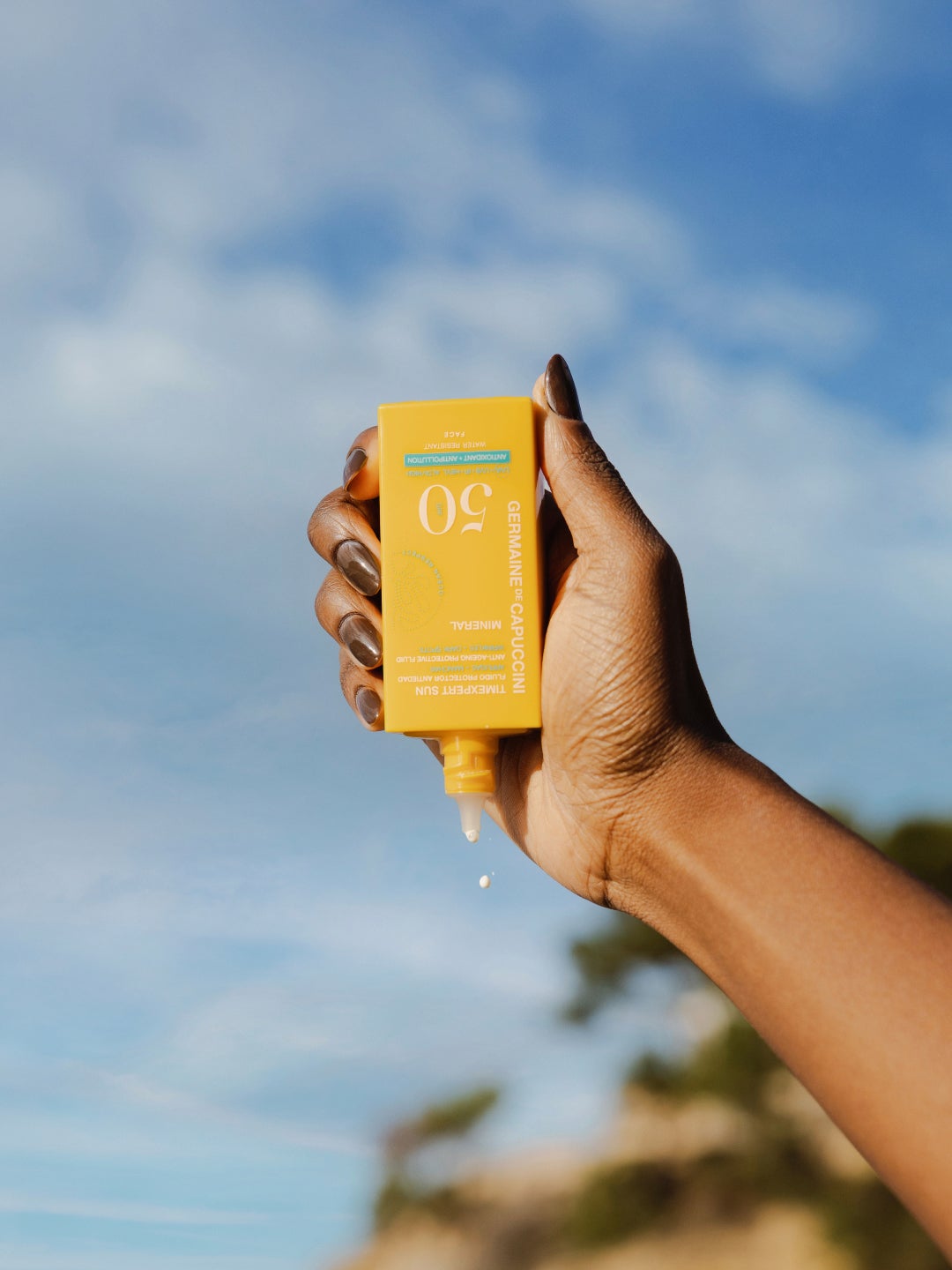
Renew your sun protection with Timexpert Sun by Germaine de Capuccini
Broad-spectrum formulas with next-generation photostable filters, anti-aging actives, and ultra-fast absorbing textures. Real protection—not just on the label.
→ Discover the Timexpert Sun range — SPF 30, 50, and 50+ protection
Myths and Application Mistakes That Reduce Your Real Protection
Mistake 1: Believing cloudy days don’t require sunscreen
Clouds filter up to 20% of UVB radiation, but UVA rays pass through almost completely. On a cloudy autumn day, your skin is still accumulating oxidative damage and photoaging. 90% of people skip sunscreen outside the summer months.
Mistake 2: Driving without sun protection
Standard car glass blocks UVB rays but allows UVA rays to pass through. Regular drivers often show asymmetry in photoaging on the driver’s side—a well-documented phenomenon in clinical dermatology.
Mistake 3: Applying less than the recommended amount
The SPF stated on the packaging is tested using 2 mg/cm² of product. Most users apply only 20–50% of that amount. This means that an SPF 50 can effectively drop to between SPF 7 and 12.
The two-finger rule: the right amount for face, neck, and décolleté is the quantity that covers the index and middle fingers placed side by side.
Mistake 4: Not reapplying your sunscreen
No sunscreen lasts all day. Friction, sweat, and oxidation reduce its effectiveness. Reapplying every 2 hours is not just a cosmetic recommendation—it’s the threshold at which protection begins to significantly decline.
The Cumulative Impact: Why Today’s Sun Damage Shows Up Ten Years Later
Skin doesn’t forget. Every unprotected exposure adds to a cumulative damage marker that is invisible in the moment but irreversible in the long term. It is estimated that between 50% and 80% of total lifetime sun damage occurs before the age of 18—mostly unintentionally: outdoor play, pools, family beach days.
At a cellular level, UV radiation creates cyclobutane pyrimidine dimers in the DNA of keratinocytes and melanocytes. These genetic errors are recognized and repaired by the skin’s natural mechanisms—nucleotide excision repair (NER). However, with aging and accumulated damage, this repair capacity becomes overwhelmed. The result is the appearance of sunspots, actinic keratoses, and in more severe cases, carcinomas or melanoma.
The most effective long-term investment in skin health is not any anti-aging serum—it’s consistent sun protection, starting from childhood.
The Science of Germaine de Capuccini: Timexpert Sun
The Timexpert Sun line by Germaine de Capuccini addresses the three most common failures in everyday sun protection:
Photostable filters: An advanced filtering system combining inorganic filters (micronized titanium dioxide and zinc oxide) with encapsulated organic filters to prevent degradation from UV radiation and environmental heat.
Anti-aging actives: Stabilized vitamin C, niacinamide, and red algae extract to help neutralize oxidative damage caused by UVA radiation—even while wearing sunscreen.
Non-comedogenic formulations: Lightweight, fast-absorbing textures designed for daily use under makeup, removing one of the main barriers to consistent sunscreen use in urban routines.
Find your ideal level of protection based on your lifestyle
SPF 30 for everyday urban use, SPF 50 for moderate exposure, and SPF 50+ for the beach, mountains, or hypersensitive skin. Discover your perfect formula with Timexpert Sun.
→ Explore the full Germaine de Capuccini sun protection range
Frequently Asked Questions
DOES SUNSCREEN EXPIRE? HOW LONG DOES IT LAST ONCE OPENED?
Yes, sunscreens do expire. The expiration date is indicated on the packaging; once opened, the PAO symbol (an open jar with a number followed by “M”) shows how many months the product remains safe to use. Most sunscreens have a PAO of 12 to 24 months.
After this period, UV filters lose stability and effectiveness, leaving your skin unprotected—even if the product still looks fine. If it’s been more than a year since you opened it, it’s time to replace it.
HOW OFTEN SHOULD YOU REAPPLY SUNSCREEN?
Yes. UVA levels remain significant through clouds and windows all year. Daily broad‑spectrum protection is one of the most reliable ways to help maintain firmness, even tone and radiance over time.
DO UVA RAYS PASS THROUGH CLOUDS AND CAR WINDOWS?
They result from a combination of factors: skin ageing, loss of collagen and elastin, facial volume reduction, repetitive muscle movements and sun exposure. Lifestyle habits such as smoking and stress, as well as genetics, also play a role. To treat them effectively, a comprehensive routine is recommended, including high-efficacy anti-ageing products like the Pro-Collagen Serum Timexpert Wrink·Less, which smooths deep wrinkles and improves skin elasticity.
DOES SUN DAMAGE FROM CHILDHOOD SHOW UP YEARS LATER?
Yes. It is estimated that between 50% and 80% of total lifetime sun damage occurs before the age of 18. Sunburns during childhood significantly increase the risk of melanoma in adulthood.
Damage to the DNA of keratinocytes is cumulative: mutations build up over time until the skin’s repair mechanisms can no longer compensate. Protecting children from the sun is the most effective anti-aging investment there is.